


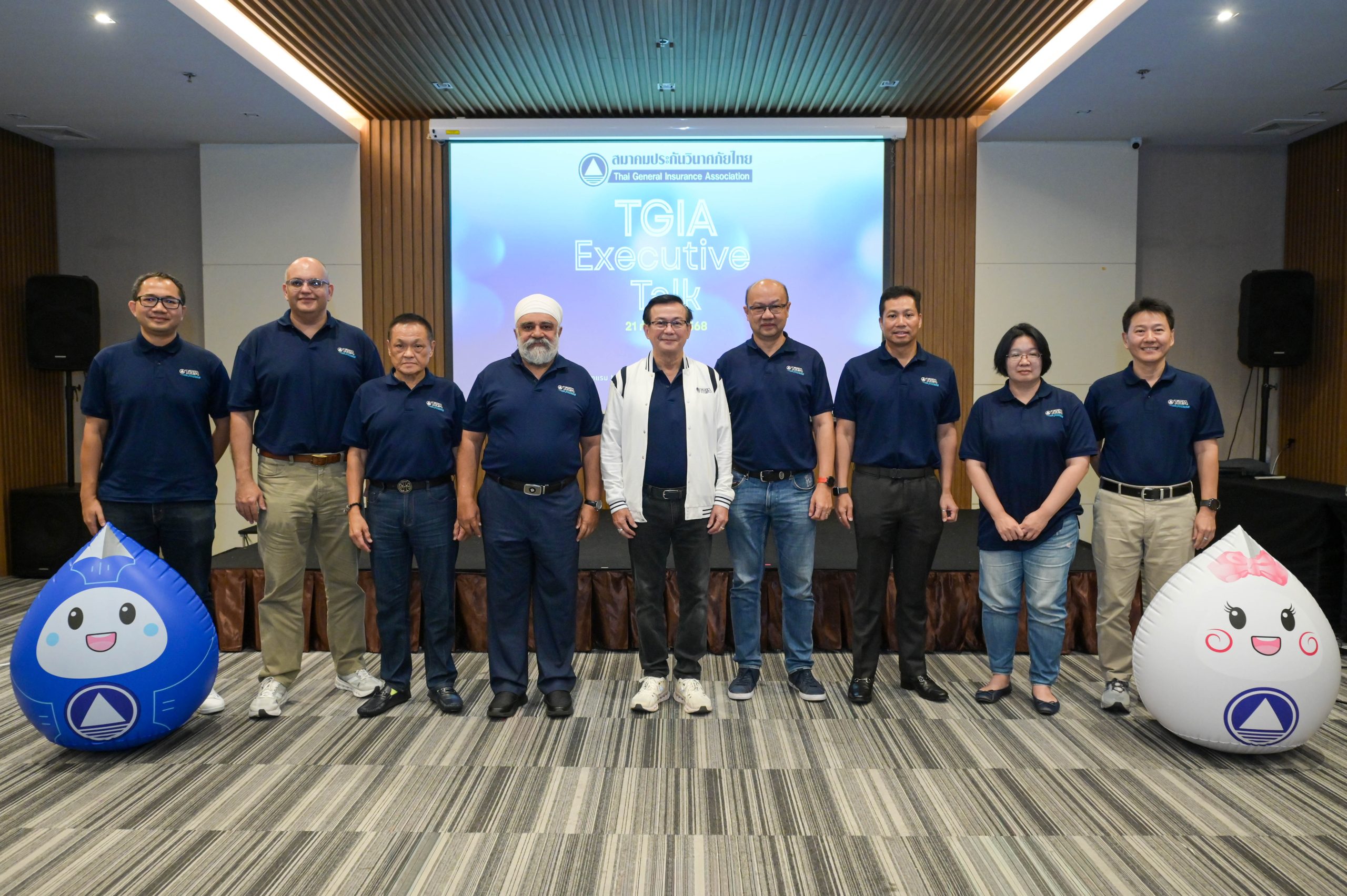
The Thai General Insurance Association held its 2025 Press Thank-You event, while opening a platform to exchange perspectives and directions for driving the industry through the Executive Talk activity, honored by Dr. Somporn Suebthawilkul, President of the Thai General Insurance Association, who gave a special lecture on “Accelerating Innovation Toward a Sustainable Insurance Business Transition in the New World,” to reflect the vision and direction of Thailand’s insurance industry, with representatives from insurance committees in various fields joining to exchange knowledge and approaches for driving Thailand’s non-life insurance industry across multiple dimensions, such as developing insurance models to address natural disasters in the non-life insurance sector, expanding the marine and logistics insurance market in the context of the trade war, as well as developing a sustainable health insurance system capable of meeting the public’s long-term needs, to push Thailand’s insurance industry to grow steadily and sustainably in the new era, by creating innovations that effectively meet the needs of both the business sector and consumers, during 20–21 September 2025 at the Mandarin Eastville Hotel, Pattaya, Chonburi Province.
On 21 September 2025, Dr. Somporn Suebthawilkul, President of the Thai General Insurance Association, delivered a lecture at the Executive Talk forum under the topic “Accelerating Innovation Toward a Sustainable Insurance Business Transition in the New World,” emphasizing the urgent need for the insurance business sector to adapt, amid the context of the “new world,” which is not merely the post-COVID-19 era, but a period of structural change across multiple dimensions — economic, technological, climatic, and consumer behavior.
Dr. Somporn Suebthawilkul, President of the Thai General Insurance Association, said today’s world is an era full of uncertainty and rapid change. The insurance business sector must therefore proactively drive innovation in every area, from developing products, services, and business processes, to designing new business models that respond to this context, particularly the full transition into a digital society, where digital-era consumers expect every step of service to be seamlessly conducted through smartphones, including purchasing insurance, filing claims, and contacting service.
At the same time, the arrival of new technologies such as AI, Big Data, IoT, Sensors, Robotics, and Blockchain has significantly changed the industry’s working processes, opening opportunities for new InsurTech players, which may not have traditional offices, to compete at the national level. The ability to understand risk and adapt quickly has therefore become a key core of the new-era business.
Another important issue is climate change, which is causing disasters that increase in frequency and severity every year, such as floods, storms, drought, and forest fires. The insurance business sector must therefore improve new risk assessment models, particularly developing Climate Risk Insurance and area-based risk management systems, such as Flood Zoning, which can be used to set premiums, coverage terms, and manage insurance company portfolios more accurately.
In addition, stakeholder expectations regarding ESG (Environment, Social, Governance) and sustainability are no longer just an option, but have become an important requirement for conducting business. Insurance companies must demonstrate responsibility to society and the environment, and must comprehensively consider the impact that their products and services have on the world.
Regarding new-era consumer behavior, Dr. Somporn pointed out that customers today have more information at hand and can quickly compare products. It is no longer just about buying because it is mandatory, but a decision based on confidence that the product offers value and can genuinely meet individual needs. Innovation in Personalized Insurance therefore plays a very important role.
In terms of product and service development, innovation must cover multiple dimensions, including Usage-Based Insurance, Embedded Insurance, and All-in-One Insurance, with technologies such as AI, Big Data, Blockchain, IoT, and Sensors playing an important role in data analysis and proactive risk management. The key focus is thinking ahead and acting before problems arise, or even before customer needs become clearly apparent.
Regarding property risk management, Dr. Somporn said that developing property insurance innovation, particularly in Flood Zoning, which can systematically divide risk areas, to be used as a basis for calculating premiums, designing policies, and managing insurance portfolios, with a proposal to create a Digital Flood Risk Map that updates data in real-time and can be used jointly between the public and private sectors, while also promoting the development of IoT technology and Geographic Information System (GIS) to support area-based risk assessment.
In terms of motor insurance, it is necessary to give importance to establishing a “benchmark price” for vehicles and repair costs using AI and Big Data systems, to update the benchmark price to reflect the market’s reality at each point in time, in order to increase transparency in offering premiums and reduce disputes in the claims process.
For accident and health insurance, approaches are proposed that emphasize preventive health care rather than paying only when illness occurs, using innovations that promote health, such as Wellness Insurance programs, Telemedicine, AI health assistants, early risk detection systems, and instant automated claims systems.
Another issue given great importance is elevating Insurance Literacy, or public understanding of insurance, through designing products that are easy to understand and genuinely accessible, such as Modular Insurance, where customers can choose specific coverage according to their budget, Bite-Sized Insurance with premiums starting at just a few baht per day, All-in-One Insurance that combines multiple types of coverage into a single package, and Embedded Insurance embedded in other services, such as booking travel tickets or purchasing goods through online platforms — all of which will help create opportunities for the public to begin accessing and learning about insurance through real experience.
Dr. Somporn concluded that Thailand’s insurance industry is at an important transition point, where adapting toward sustainability cannot happen by adjusting only products or distribution channels alone, but requires developing data infrastructure, modern risk management, and providing accurate knowledge to the public, while emphasizing that driving innovation effectively requires cooperation between the government, private sector, and civil society, so that the insurance system can continue to play an important role in risk management to build sustainable economic and social stability for the country in the long term.