


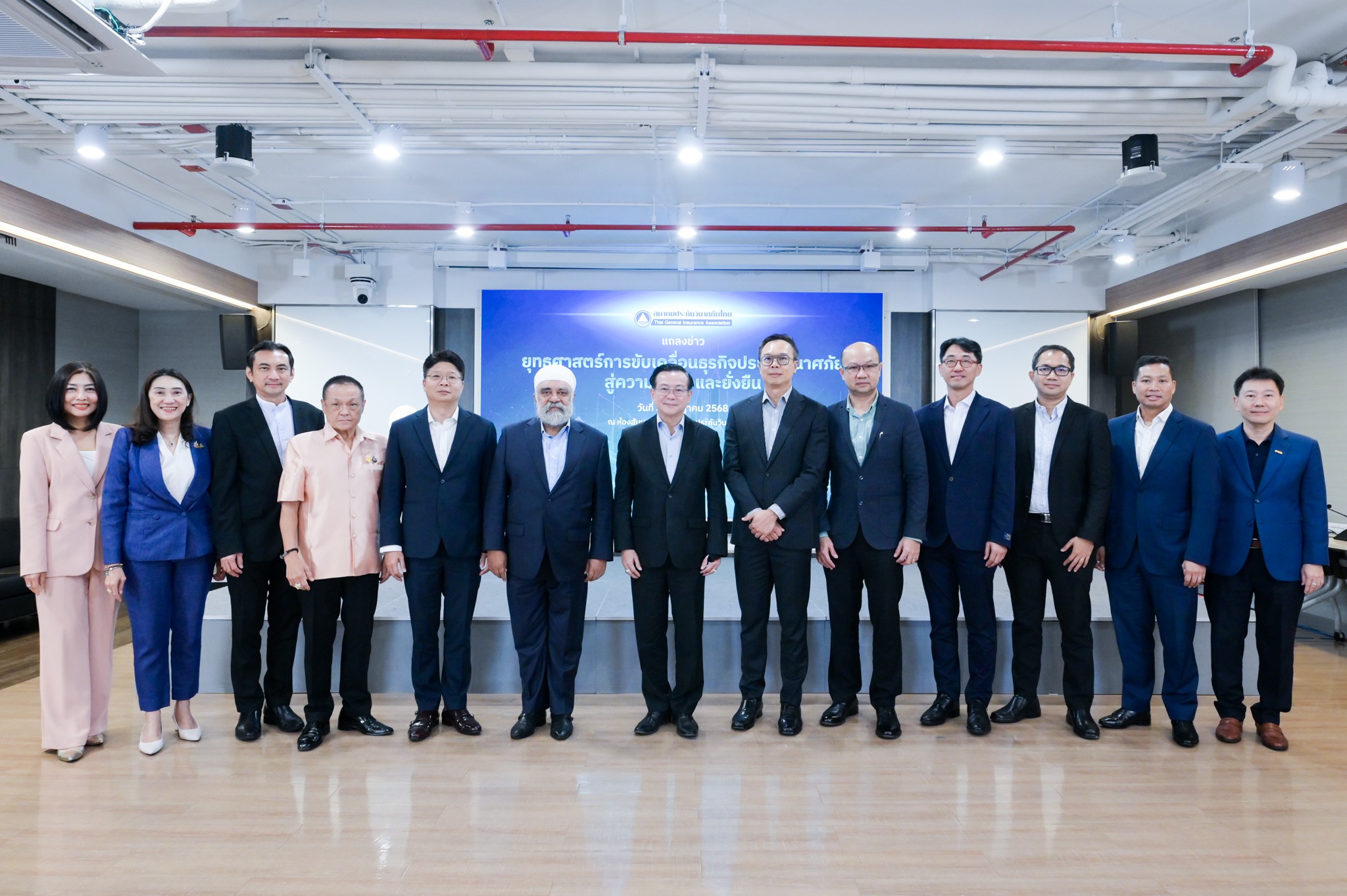
The Executive Committee of the Thai General Insurance Association for 2025-2027, under the leadership of “Dr. Somporn Suebthawilkul,” who holds the position of President of the Thai General Insurance Association for a second consecutive term with a two-year term of office, announced a strategic plan for developing Thailand’s non-life insurance industry, aiming to drive the non-life insurance business to grow steadily and sustainably, ready to cope with economic, social, and technological changes, focusing on raising the industry’s potential in every dimension, moving forward to integrate work plans together with the insurance committees in various fields to push forward concrete progress.
Dr. Somporn Suebthawilkul, President of the Thai General Insurance Association, said that following the election of the Association’s new Executive Committee for 2025-2027, and the election of persons to hold various positions, along with the appointment of advisors to the Executive Committee, all now complete, with a two-year term of office, the Executive Committee has jointly set the framework and direction for the Association’s strategy, continuing to aim to be an organization that promotes and supports the non-life insurance business as a pillar of the country’s economic and social system sustainably, adhering to the policy of acting as a professional risk manager for the public and private sectors, emphasizing professionalism, establishing operational standards as a guideline for transparent business operations, together with helping society in various dimensions, to drive Thailand’s non-life insurance business toward stable growth, and serve as an important mechanism in strengthening economic and social resilience, in line with the Office of Insurance Commission’s 5th Insurance Development Plan (2025-2030), which focuses on 4 key missions, as follows:
Mission 1: Strengthen confidence and raise the capability of the non-life insurance business, including promoting operations with social and environmental responsibility, developing and disseminating insurance knowledge to build correct understanding among the public and society, together with promoting proactive communication through digital technology to increase efficient channels for accessing insurance information, as well as establishing service standards for the business sector to raise trust in the insurance system, while strengthening competitiveness through innovation, insurance products, and proactive marketing, promoting sustainable business operations (ESG) to create shared value and positive impact on society and the environment.
Mission 2: Promote and support industry growth through innovation and technology, while strengthening the role as a professional risk manager for the public and private sectors, promoting the adoption of digital technology such as InsurTech and Big Data to increase efficiency in managing risk in every dimension, including supporting the development of new insurance products that respond to emerging risks such as natural disasters, cyber risks, and challenges in the digital economy, as well as developing insurance products suited to the needs of the public in each target group. This also emphasizes promoting education, research, and innovation development in non-life insurance, to sustainably raise the industry’s competitiveness, while pushing the government to integrate insurance into national strategic plans, for use in comprehensively and efficiently managing both economic and social risk.
Mission 3: Push forward policies, regulations, and infrastructure that support the growth of the non-life insurance business, reviewing and pushing forward improvements to regulations that are obstacles to business operations (Regulatory Guillotine), while proposing new regulations that support the growth and expansion of the non-life insurance business. In addition, this also promotes the establishment of a Regulatory Sandbox that supports safe and efficient testing and development of insurance innovation, together with improving investment criteria for insurance companies to be more flexible, in line with ever-changing economic conditions, including promoting the ability of the business to expand into neighboring countries securely, and supporting the development of the industry’s data infrastructure, such as a Centralized Data System, to raise data analysis capability and more transparent and efficient supervision.
Mission 4: Strengthen an insurance ecosystem that supports business operations to grow steadily and stably, promoting the creation and development of personnel entering the non-life insurance business, focusing on raising the knowledge standards of personnel to be expert and excellent, to support the industry’s sustainable growth, while developing cooperation between insurance companies in exchanging knowledge, building networks, and strengthening competitive capability at the organizational level. This also focuses on strengthening cooperation and good relationships with regulatory agencies and related agencies, to create mutual support in policy and supervision, while expanding cooperation with international organizations, to raise the standards of Thailand’s industry operations and practices to international levels.
It can therefore be seen that all 4 missions in this strategic plan work together in an integrated manner, to raise Thailand’s non-life insurance industry to be an important mechanism of economic stability and national risk management, with the Association serving as the “center” that combines cooperation from all sectors, not only to drive business growth alone, but to create a Thai insurance system that the public trusts, the government can rely on, and the Thai economy is strong and sustainable at the same time.
Dr. Somporn spoke about the overall economy and the overall non-life insurance business in the first quarter of 2025, saying that, according to the assessment of the Office of the National Economic and Social Development Council (NESDC), in the first quarter of 2025, Thailand’s Gross Domestic Product (GDP) expanded by 3.1% compared to the same period of the previous year, with the main supporting factors being the export sector of goods and services, which expanded by 13.8%, and government investment, which expanded by 26.3%, while private consumption slowed, expanding by only 2.6%, while private investment contracted by -0.9%, reflecting pressure in the domestic economic sector. NESDC has also revised down its forecast for Thailand’s economic growth rate in 2025 to a range of 1.3% to 2.3%, due to uncertainty in the global economy and the impact of trade protectionist policies of trading partner countries, particularly the United States.
Meanwhile, the overall non-life insurance business in the first quarter of 2025 (January–March) had total direct premiums of 75,269 million baht, representing a growth rate of 3.81% compared to the same period of the previous year, with direct premiums by type as follows: motor insurance had direct premiums of 42,004 million baht, an increase of 1.36%; fire insurance had direct premiums of 2,509 million baht, an increase of 5.83%; marine and transport insurance had premiums of 1,668 million baht, a decrease of 4.91%; and miscellaneous insurance had premiums of 29,088 million baht, an increase of 8.01%, which shows the continuing recovery trend of Thailand’s non-life insurance business sector, particularly in the miscellaneous insurance and fire insurance groups, which had outstanding growth rates, reflecting increased demand for coverage in certain risk groups. Although marine and transport insurance contracted slightly, reflecting a slowdown in certain sectors of international trade, the overall business continues to grow in a positive direction, and indicates the strength of the overall market. If this trend continues in subsequent quarters, it is highly likely that the non-life insurance industry in 2025 will be able to grow close to the level forecast for the full year. From the direct premium data in the first quarter of 2025, with a total value of 75,269 million baht, the proportion of premiums is divided into motor insurance, accounting for 55.8% of total premiums, or 42,004 million baht, and non-motor insurance, accounting for 44.2%, or 33,265 million baht, reflecting increased risk management awareness among businesses and the general public, particularly in the fire insurance, miscellaneous insurance, and health insurance categories.
For the growth trend of the non-life insurance business for the full year 2025, based on an analysis of the overall non-life insurance business by Thai Insurance Research & Development Co., Ltd. (TIRD), the non-life insurance business is expected to grow at a rate of 1.5% to 2.5% compared to the previous year, with total direct premiums in the range of approximately 291,000–294,000 million baht. This growth reflects the challenges in the recovery of the domestic economy, as well as the insurance business sector’s adaptation to a rapidly changing environment, both in terms of new risks, technology, and consumer behavior. The non-life insurance business continues to show the ability to adapt, operate efficiently, and move toward sustainable development, all of which are important factors that help strengthen the business in the long term. Continuous monitoring of in-depth information, together with strategic planning consistent with the new context, will be a key to driving the non-life insurance business to grow steadily in 2025 and into the future.
Dr. Somporn also spoke further about the Thailand Reinsurance Conference 2025, or TRC 2025, saying that in 2025, the Thai General Insurance Association (TGIA) and the Thai Insurance Brokers Association (TIBA) are jointly hosting the Thailand Reinsurance Conference 2025, or TRC 2025, for the first time in Thailand, under the topic “Unlocking Reinsurance Opportunities in a Changing Climate: Building Catastrophe Resilience in Thailand,” held during 30 October – 1 November 2025 at The Athenee Hotel, Bangkok, Thailand.
The Thailand Reinsurance Conference 2025 is considered an important step for Thailand’s non-life insurance industry, as it is the first time Thailand has hosted an international-level reinsurance conference. In the past, this type of conference has typically been held in other countries such as Hong Kong, Singapore, or other major regional cities, with representatives from Thailand’s non-life insurance industry regularly having to travel abroad to attend, even though Thailand actually has high potential to be a center of the non-life insurance industry in the ASEAN region, whether in terms of continuously growing premium volume, or the fact that Thailand is one of the important destinations for reinsurance companies and reinsurance brokerage firms from around the world, who regularly travel to visit and talk with domestic insurance companies.
For this reason, the Association intends to hold an international-level forum under the name Thailand Reinsurance Conference, to provide an opportunity for reinsurance companies and reinsurance brokerage firms from around the world to experience, understand, and build direct relationships with executives in Thailand’s non-life insurance business sector, which we strongly believe will be another important mechanism to help promote Thailand’s rise as a reinsurance center in the ASEAN region, particularly at this time when the region’s insurance system is in a period of transition and rapid development. To achieve continuous results, this conference will be the starting point for holding the event on an ongoing basis, to build familiarity and confidence for reinsurance companies and reinsurance brokerage firms worldwide in connecting with Thailand’s insurance market.
In its first year, this event has received an excellent response from both companies and related agencies at the regional and global levels, such as reinsurers, reinsurance brokers, surveyors and loss adjustors, as well as various related organizations, with more than 400 participants expected to attend.
“The Thai General Insurance Association is committed to developing Thailand’s insurance industry to grow on a stable foundation, while driving the non-life insurance business to serve as a pillar in strengthening the country’s economic and social stability, emphasizing an important role as a risk management tool in every dimension of the economic system, operating under principles of good governance, transparency, and responsibility to society and the public, together with promoting the development of policy, technology, and human resources comprehensively, to increase the competitiveness of the business sector, effectively support new forms of risk, respond to society’s expectations, and drive it to be an important mechanism in creating stability and economic sustainability for the country in the long term,” the President of the Thai General Insurance Association concluded.
In addition, the insurance committees in various fields jointly announced their operational plans to drive the non-life insurance business, as follows:
Mr. Hakim Benraheem, Chairman of the Property Insurance Committee, spoke about claims settlement measures for the earthquake case, saying that following the earthquake that occurred on 28 March 2025, which caused damage to buildings, homes, and property of the public in many areas across Thailand, the Association has issued various measures to ensure that the assessment and settlement of claims for policyholders is convenient and fast, and to accelerate the relief of damage suffered by policyholders, including preparing various information to help non-life insurance companies fully consider and verify insurance information, and to help make claims settlement for policyholders convenient, complete, and accurate, such as preparing a condominium building database for insurance companies to verify condominium building information in Thailand and condominium building insurance.
This is to reduce the steps in verifying information between insurance companies, since most condominium buildings have insurance for both the juristic person and the unit owners, so if the insurance company insuring the juristic person uses the services of a particular loss assessor, the insurer of the unit owner can choose to use the same loss assessor.
And since condominium buildings insured by both the juristic person and the unit owner must, according to insurance principles, have the insuring companies share the damage in proportion to what they have insured, therefore, to prevent policyholders from being affected and to accelerate the relief of damage that has occurred, non-life insurance companies have jointly signed a memorandum of understanding setting out approaches for verifying and proceeding with claims payment, in the case where a policyholder has more than one insurance policy covering the same property.
At the same time, valuation information along with general repair costs has been prepared, to be used as basic information for comparison in assessing claims for condominium units and residential buildings, to build confidence for policyholders that they will receive compensation according to the actual damage that occurred.
In addition, the Thai General Insurance Association and the Thai Bankers’ Association have jointly established measures to assist home loan customers with insurance, for those affected by the earthquake situation, so that policyholders can receive claims directly, for use in repairing and renovating residential buildings, with several banks cooperating by allowing non-life insurance companies to pay claims directly to policyholders, or in some cases, verifying the rights and status of loan customers on a case-by-case basis for further claims payment.
From the earthquake situation that occurred, the non-life insurance business sector has become aware of risks that may occur in the future, and recognizes the importance of systematic preparedness, to support unpredictable disaster events, to strengthen sustainable risk management capability, and maintain the role of the insurance business as an important mechanism for the country’s risk management. The non-life insurance business sector has therefore held discussions to establish approaches for future earthquake insurance underwriting, taking into account the appropriateness of premium rates, as well as the risk-bearing capacity of insurance companies.
This approach will cover risk management through reinsurance, which will help spread risk and increase the capacity to support large-scale disasters, which will enable the insurance business to underwrite earthquake insurance efficiently and stably in the long term.
Mr. Seri Kawinrachatarot, Chairman of the Motor Insurance Committee, spoke about the adjustment of coverage under motor insurance policies, saying that the Motor Insurance Committee, together with the Office of Insurance Commission (OIC), has been continuously studying information on adjusting premium rates and coverage under motor insurance policies since March 2025, with the objective of raising the level of protection for road accident victims from major accidents, and/or large-scale accidents with more than 20 deaths or permanent disabilities in that accident.
From the discussions, a resolution was passed to approve increasing the maximum coverage amount for death or total permanent disability per occurrence, so that road accident victims have the opportunity to receive claims up to the full maximum coverage amount of 500,000 baht per person as specified in the motor insurance policy, with the following key points:
1. Compulsory motor insurance (Por Ror Bor) has adjusted the coverage amount in the case of death or total permanent disability, from the previous limit of not exceeding 5 million baht per accident for vehicles with no more than 7 seats, or passenger trucks carrying no more than 7 people including the driver, and not exceeding 10 million baht per accident for vehicles with more than 7 seats, or passenger trucks carrying more than 7 people including the driver, by cancelling the previous coverage amount criteria and increasing the maximum coverage amount for death or total permanent disability per occurrence to 20 million baht, covering all types of vehicles. This coverage adjustment will not involve any increase in premiums, and is requested to take effect immediately for all insurance policies, both policies still within their coverage period and new contracts made with insurance companies.
2. Voluntary motor insurance: increased the coverage amount for Third Party Bodily Injury (TPBI) liability, from a previous minimum of not less than 10 million baht per occurrence, to not less than 20 million baht per occurrence. Policyholders can choose to purchase higher levels of TPBI coverage according to their needs, choosing a minimum coverage of 20 million baht per occurrence, up to unlimited coverage. This increased coverage is requested to take effect from 1 January 2026 onward, for voluntary motor insurance policies newly contracted with insurance companies.
This adjustment of coverage under motor insurance policies reflects the commitment of the OIC and the non-life insurance business sector to develop and raise the level of protection for road accident victims to be appropriate and sufficient for actual situations that occur, and it is expected that the OIC will issue a notification to bring this into effect soon.
Regarding the issuance of insurance policies in e-Policy format, the Motor Insurance Committee has held discussions with the OIC on promoting the issuance of insurance policies in e-Policy format, so that vehicle owners can arrange compulsory motor insurance conveniently and quickly, and can check their own insurance information throughout the coverage period, with the objective of facilitating policyholders to access and check policy information quickly, and also as an option for policyholders who do not wish to receive paper policies.
Mr. Piyaphat Wanaukrit, Chairman of the Accident and Health Insurance Committee, spoke about progress on grouping non-life insurance network hospitals, saying that the Thai General Insurance Association has studied approaches for grouping non-life insurance network hospitals, most of which are private hospitals, by considering grouping hospitals based on treatment costs into several groups. This data analysis used health insurance claims data from 2023, which accounted for 51% of health insurance claims on the non-life insurance side, and used data specifically for inpatient (IPD) cases of 15 diseases and 9 procedures that are commonly found and have less varied and complex treatment methods, accounting for 70% of inpatient (IPD) treatment costs. The study results for grouping non-life insurance network hospitals are summarized as follows:
1) Analysis results of private hospital grouping: From the data analysis, in the case of dividing private hospitals into 3 groups, namely High, Medium, and Low, it was found that hospitals in the High group have treatment costs 1.5 times higher than hospitals in the Medium group, and hospitals in the Medium group have treatment costs 2.2 times higher than hospitals in the Low group. And in the case of dividing private hospitals into 2 groups, namely High and Non High, it was found that hospitals in the High group have treatment costs 1.51 times higher than the Non High group.
2) Analysis results of government hospitals under the Ministry of Public Health: From the data analysis, using treatment cost data from the Thai DRG program of the Comptroller General’s Department, which is treatment cost excluding Administration Expense and salary, it was found that treatment costs of private hospitals in the Medium group are on average 6.1 times higher than the Comptroller General’s Department price. To be consistent with this hospital network grouping, the committee has submitted for approval a form of coverage for treatment at designated hospitals or medical facilities, so that insurance companies can use the hospital grouping study results to set appropriate premium rates for each group.
Therefore, grouping non-life insurance network hospitals brings benefits in several dimensions, including: policyholders can choose to purchase health insurance consistent with their income and needs, enabling the public to access the private health insurance system more, while insurance companies can manage risk and control costs efficiently, while developing diverse products that meet consumer needs, and overall it also helps reduce the country’s healthcare expense burden, strengthening the sustainability of the overall health insurance system.
Mr. Pirat Wongsaisuwan, Registrar and Chairman of the Law and Regulation Committee, disclosed regarding the exercise of the right to terminate insurance policies by non-life insurance brokers, that it is currently found that some policyholders who take out motor insurance with insurance companies have entered into loan agreements with insurance brokerage companies to pay motor insurance premiums, since motor insurance requires premium payment before coverage is provided, under the Cash Before Cover principle. This eases the burden of paying premiums, by borrowing money to pay the premium, and paying in installments to the non-life insurance broker instead. These loan agreements have set contract conditions that, in the case the borrower cannot pay the loan in installments, the borrower (policyholder) grants advance power of attorney to transfer rights to the insurance broker to exercise the right to terminate the insurance policy, and receive a refund of premium in proportion to the remaining coverage period, to offset the refunded premium against the outstanding loan.
From this case, the Thai Insurance Brokers Association has held discussions with the Thai General Insurance Association and the OIC, so that insurance brokerage companies and insurance companies have legally correct practices, and do not affect the rights of policyholders in cases where insurance brokers exercise the right to terminate insurance policies on behalf of policyholders.
The OIC has established practice guidelines stating that the contract between the policyholder and the insurance company (insurance contract) and the contract between the policyholder (debtor) and the insurance brokerage company (creditor) (loan contract) must be clearly separated. Therefore, in the case where a policyholder cannot repay the loan (premium) installments to the insurance brokerage company, and the insurance brokerage company subsequently exercises the right to terminate the insurance policy under that loan contract, this is not a legal duty of the insurance broker. Furthermore, such a contract is a standard form contract that requires the policyholder to grant power of attorney to terminate the insurance policy to the insurance broker, which may result in the policyholder losing rights without clearly knowing or understanding the conditions, and therefore may constitute an unfair contract term, and an act contrary to legal principles, including constituting a conflict of interest in performing duties as a representative of the policyholder, for which the insurance broker may have their license revoked under the law on non-life insurance.
However, if a loan contract has been made to pay the insurance premium, but the policyholder cannot pay the premium installments, for the insurance brokerage company to terminate the insurance policy and receive a refund of the premium, clear consent must be obtained from the policyholder, as follows:
1. If there is a default in payment, and the policyholder wishes to grant power of attorney to the insurance broker to terminate the insurance policy on their behalf, there must be a document showing clear intent after the default in payment, such as a power of attorney letter, electronic message, or audio file.
2. The insurance broker can receive a refund of the premium in the remaining proportion to offset the debt, only after obtaining clear consent from the policyholder.
This practice guideline is to protect policyholders so that they receive coverage according to the conditions specified in the insurance policy, and to prevent future complaints that may arise.